Cleafy SEO Teardown: One Broken Link on 48 Pages, Thin Content Across Half the Site
SEO Teardown: Cleafy.com
Crawl data as of October 20, 2026. Analysis powered by redCacti.
What is Cleafy.com?
Cleafy is a fraud operations platform being used by digital banking platforms and helps prevent/identify cases of account takeover, session manipulation, and other scenarios. Cleafy is headquartered in Italy.
Why are we doing this?
Cleafy is an established website set up since 2014. Through this exercise, we are trying to identify elements that could impact its search presence and help other practitioners learn what typically goes wrong and how they could avoid it.
We have also reached out to Cleafy’s team with the findings and are happy to share detailed reports with them.
Our methodology
Using redCacti’s inhouse spiders, we crawled Cleafy’s website on October 20, 2026. We replicate a search engine crawler’s behavior on any site and use baked-in mechanisms without burdening the site’s resources. This includes limiting crawls to less than 3 pages a second, exponential backoffs among others.
Findings
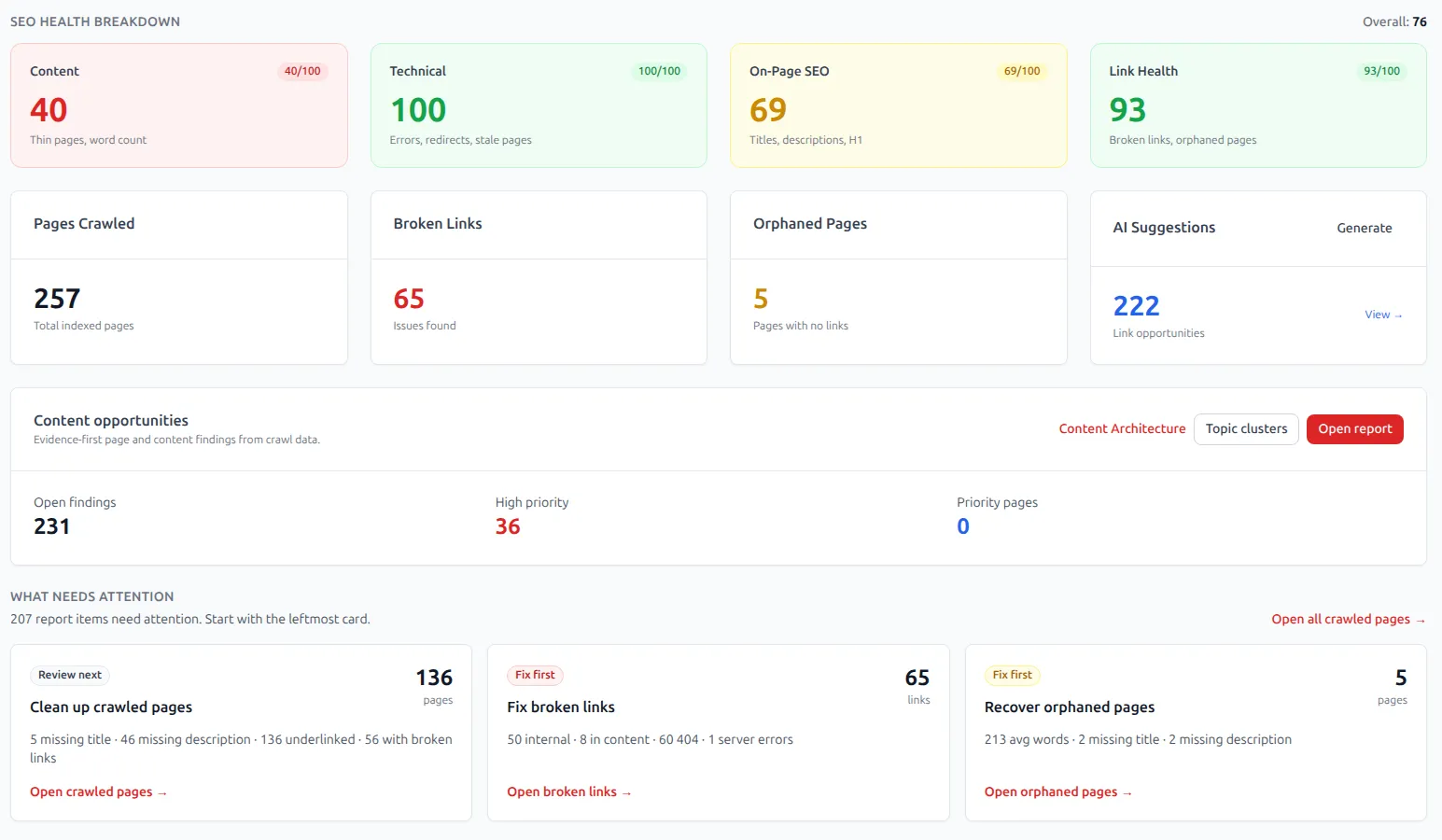
Cleafy has a decent website with 257 pages. Pages are well defined in most cases with meta tags, title, schema, and alt text for images. Cleafy has definitely done a great job on the overall website with clear messaging and well structured nav bar and footer area.
The below issues typically slip past most practitioners because they do not have a way to verify crawl level information themselves.
A single broken link shows up on 48 pages.
The link to https://www.cleafy.com/home-backup appears on 48 pages, all of them in the cleafy-labs section. This is repeated site-wide. This is also the kind of issue that slips past page-by-page review and is best caught by looking at which links appear over and over again rather than fixing them one at a time.
More than 3,600 images have no alt text.
Alt text coverage stands at 17.48% on an average basis, which works amounts to roughly 3,600 of the site’s 4,400 images. This means that 4 out of 5 images miss out on showing up on image search engines and are likely skipped getting indexed.
5 pages do not exist but show up in crawls.
For example, https://www.cleafy.com/document-category/press-releases returns not found even though it is still linked to.
26 pages just show Cleafy in the page title.
These are webinar and category pages where the title is showing up as part of a template. On top of that, 12 more titles repeat across real pages, the same checklist or announcement on two URLs. In total only 216 of 257 pages carry a distinct title, which leaves Google picking between identical pages instead of ranking either properly.
46 pages have no meta description.
And 13 descriptions repeat. Combined with the missing and duplicate titles, roughly one in five pages is either missing or reusing the two most basic on-page signals - titles and meta description. It is easy to miss, and at the same time the easiest thing for a tool like redCacti.com to flag on a regular cadence.
The site has 50 internal broken links and 15 external links.
These are a mix of broken as well as others status codes like 503 (service unavailable). Of all the broken links, the link https://www.cleafy.com/home-backup appears multiple times. It seems to be part of a template and shows up on sections like cleafy-labs.
More than half the site is thin content.
130 of 257 pages come in under 300 words, concentrated in the insights (56 pages) and author (20 pages) sections. These are effectively thin tiles built from a template rather than standalone content. Thin pages are hard to rank for anything on their own and tend to dilute crawl budget when they pile up.
35 hard-to-reach content pages have nothing pointing to them.
Cleafy has announced funding rounds, analyst placements, and threat research, yet 35 hard-to-reach content pages have nothing pointing to them. When a site’s own best announcements have no internal linking support, they most likely don’t get link equity and get no visibility.
Roughly two-thirds of the site has no structured data.
Some pages have AI schema and OpenGraph metadata, while a lot of pages do not have those. In fact, around 170 of 257 pages have no structured data, and only one page carries non-Article schema. A handful of pages also either miss a canonical or point to a canonical that differs from their own URL, which can split link equity on top of everything else.
Learnings
Broken links are the lowest hanging fruit to fix for Cleafy. It helps to check the broken links reports and see which are some common links that show up and see if they belong to a template. Same goes for page title in templates in the case of webinar and category pages. Ideally, each page should have its own title.
Old pages that show up as ‘Not Found’ need to be redirected to other relevant pages so that link equity can be transferred. The 5 pages in that state include https://www.cleafy.com/home-backup, which is still receiving 48 incoming links. All of its link equity is currently going nowhere.
Adding alt text for images, updating schema and meta tags are ongoing activities. A tool like redcacti.com can help maintain a cadence and identify any new issues that have come up between last crawl and the current one.
If we had to order the fixes, broken links and template issues come first, then the missing and duplicate titles and descriptions, then the thin pages and buried press content, then alt text, then schema and OpenGraph. Starting at the top clears the cheap wins before the slower ongoing work.
If you are running a site like Cleafy’s, and most product sites are, the same issues probably live in your crawl too, not just theirs. Run a free crawl using redcacti.com and see your broken links, thin pages, and template mistakes in the same detail. The teardown above is the method.
Liked this article? Forward to people who could benefit from it.
Newsletter
Weekly SEO teardowns
Internal linking, broken links & orphan pages - straight to your inbox, every week.