Hub strength
Review whether a central page connects the related content that supports it.
Topic clusters
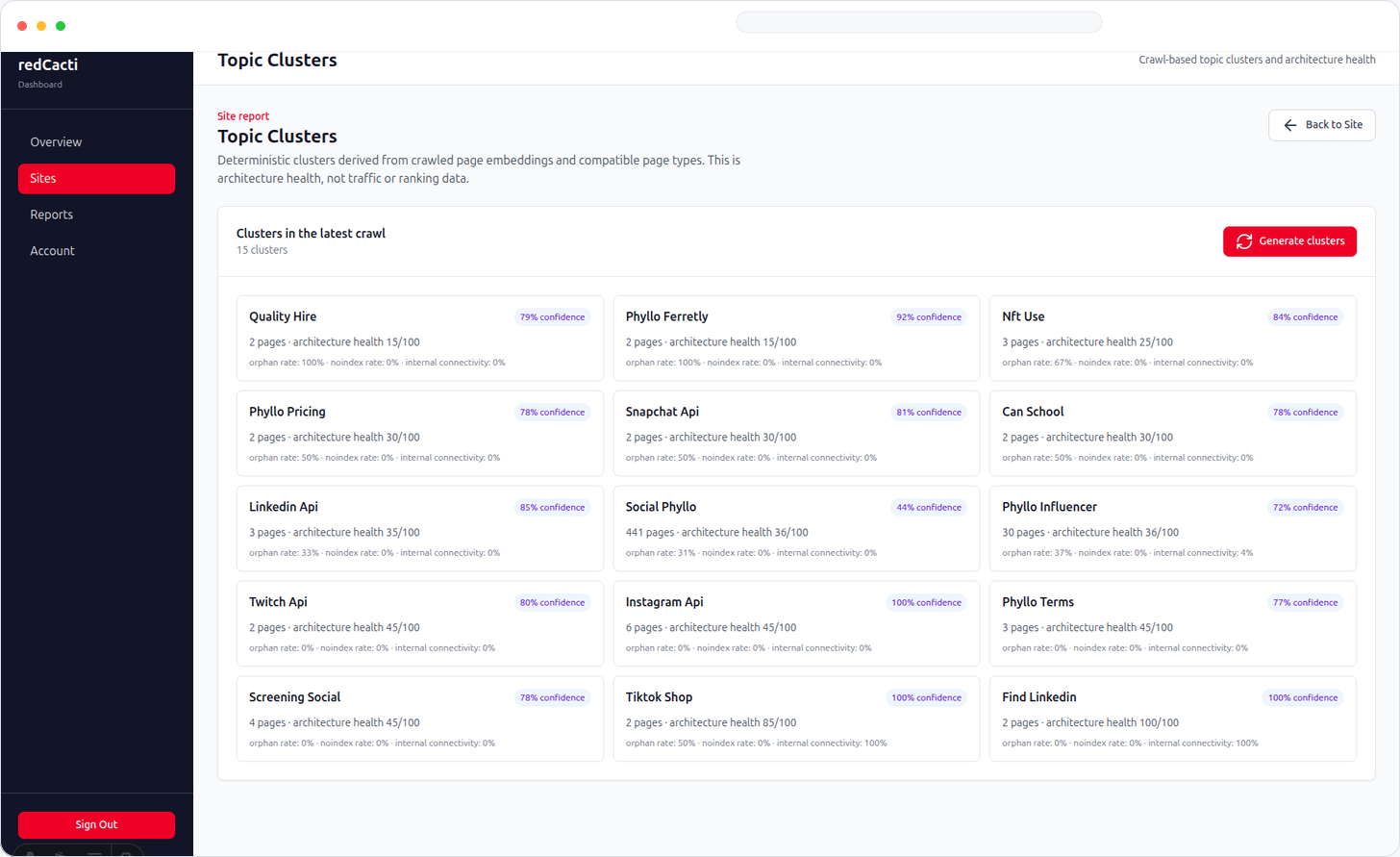
A topic list is not an architecture. redCacti uses crawl evidence to help you review hubs, supporting pages, link context, fragmented groups, and possible missing connections across a content-heavy site.
What to inspect
Use the report to ask better structural questions. Which page acts as the hub? Which supporting pages link back? Where does context stop? Which related pages are stranded in another part of the site?
Review whether a central page connects the related content that supports it.
Trace links between guides, use cases, feature pages, and deeper resources.
Find groups that appear related but are separated by weak or missing internal paths.
Use missing connections and possible hubs as prompts for human editorial review.
Evidence for editorial action
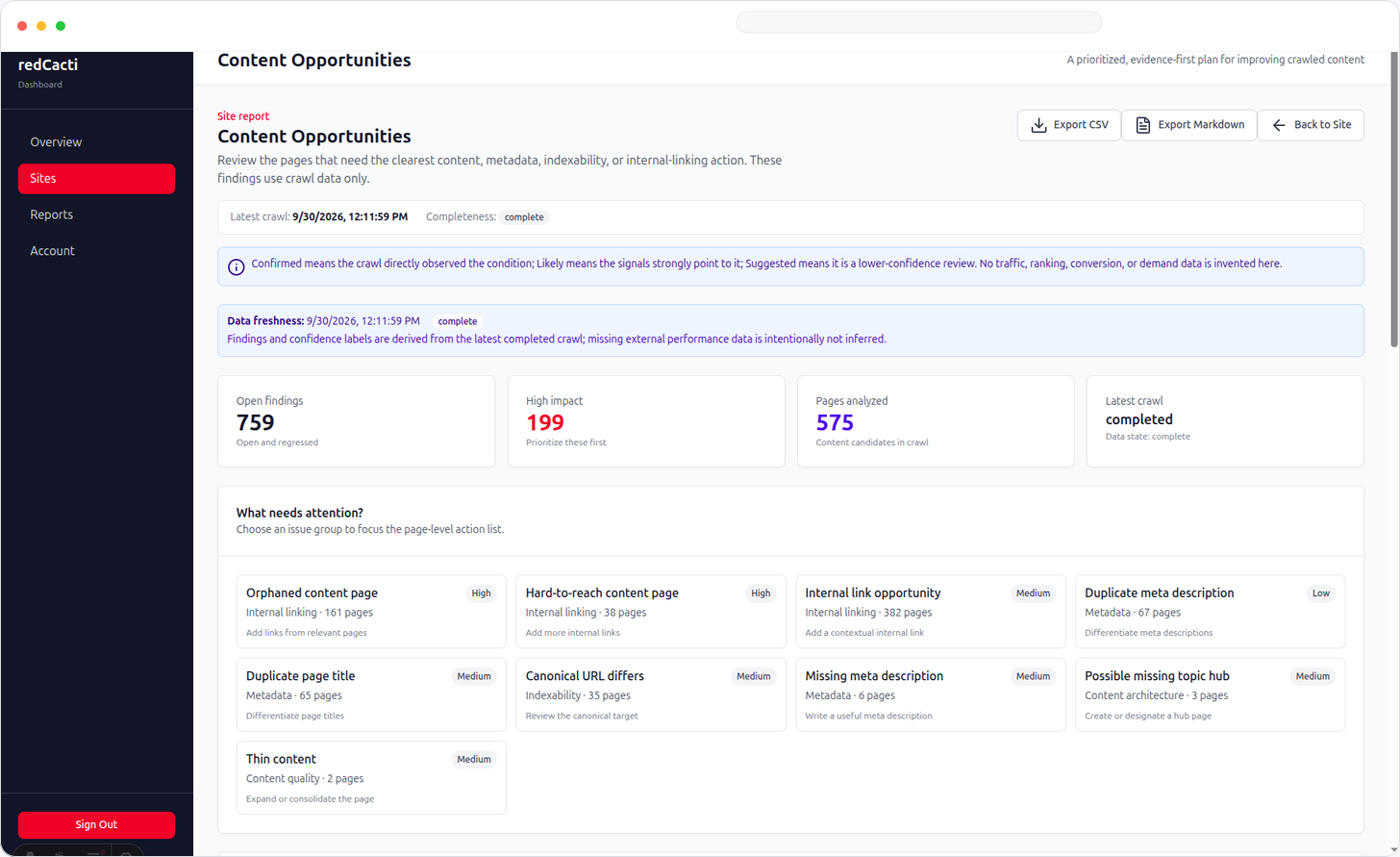
Review structural evidence to decide where a hub, bridge, or contextual link deserves investigation. Then bring the audience and business context that only your team can provide.
Inspect confidence and impact before prioritizing.
Approve changes with the people who own the content.
Compare later crawls to see whether paths changed.
Start with public pages and the links exposed by the crawl.
Review related pages, observed hubs, incoming links, and contextual paths.
Check whether a weak connection is intentional, missing, or a classification edge case.
Balance structural evidence with editorial goals and business context.
After approved changes, compare the next crawl with the earlier state.
Use the observed paths as a starting point, add your team's audience and business context, and compare the next crawl after approved changes.
It is a related set of pages and the internal links observed between them. A crawl can show whether those pages have clear hubs, supporting paths, and bridges to related groups.
Use the observed relationships and possible gaps as a starting point. Your team adds audience, business context, search demand, and editorial judgment before choosing the next piece of work.
A possible missing hub is a structural prompt where related pages exist but the crawl does not show a clear connecting page or path. It is a review hypothesis, not an automatic content brief.