Reachability and crawl depth
See whether a page is reachable from the crawl start and how many link steps away it sits.
Content architecture
redCacti turns a public crawl into an evidence trail for how pages connect. Find isolated and near-isolated pages, understand crawl depth and reachability, and give every structural recommendation a page-level reason.
Crawl evidence is not traffic, ranking, demand, conversion, or revenue data.
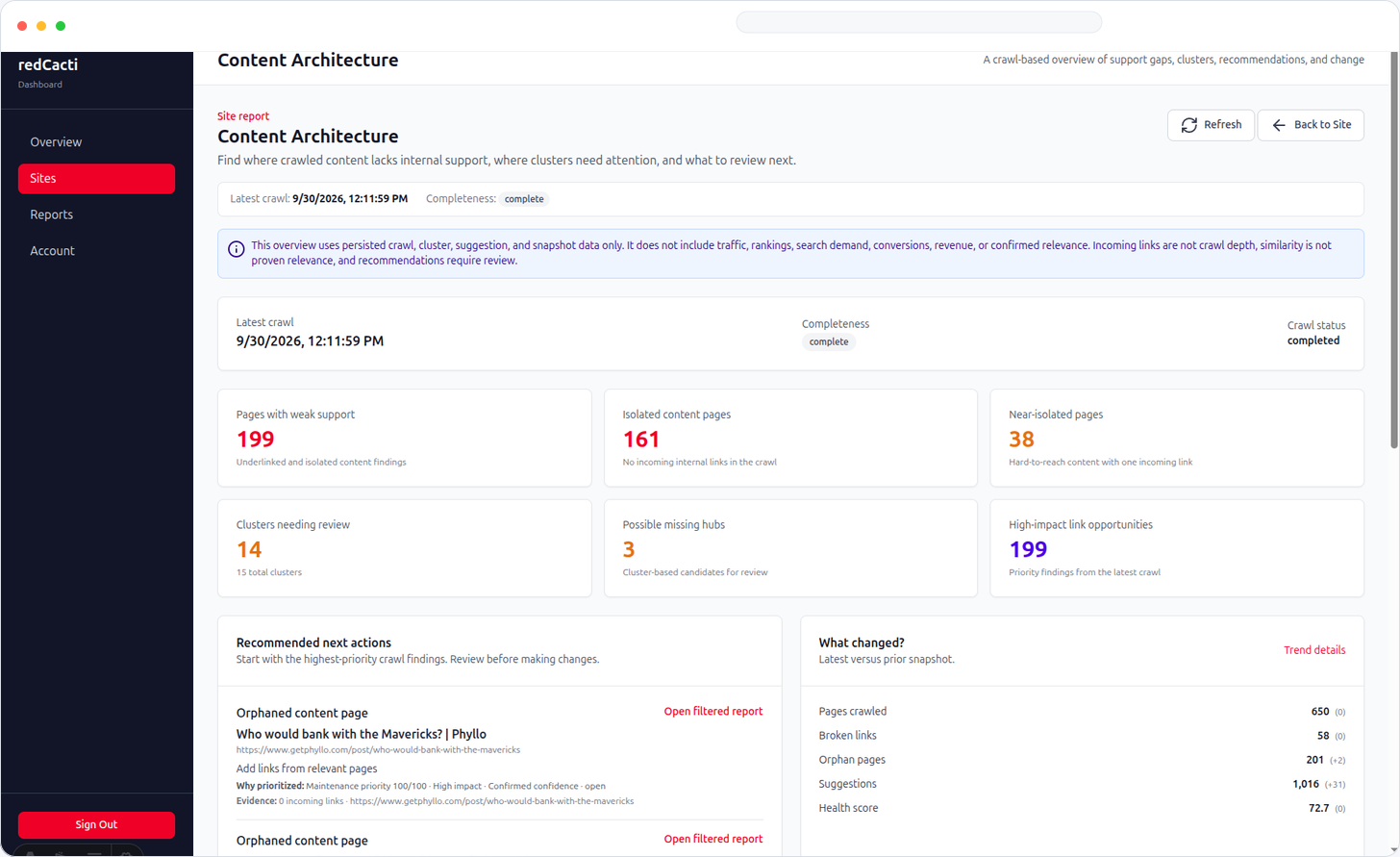
Read the graph
A crawl does not tell you which page deserves more traffic. It does show the paths available to the crawler and the places where your structure loses context.
See whether a page is reachable from the crawl start and how many link steps away it sits.
Find pages with no observed incoming internal links, or pages supported by only a narrow path.
Review who links to a page and whether the surrounding link context supports a useful journey.
Group crawl results by observed page patterns so repeated template issues are easier to review.
Spot content groups with weak hub connections, missing bridges, or unclear relationships.
Use structural gaps as prompts for editorial review, not as automatic prescriptions.
Page-level evidence
Move from a high-level architecture signal to the actual pages behind it. Review incoming links, depth, classification, and the latest crawl before deciding whether to update navigation, add context, or leave the page alone.
See orphan page workflows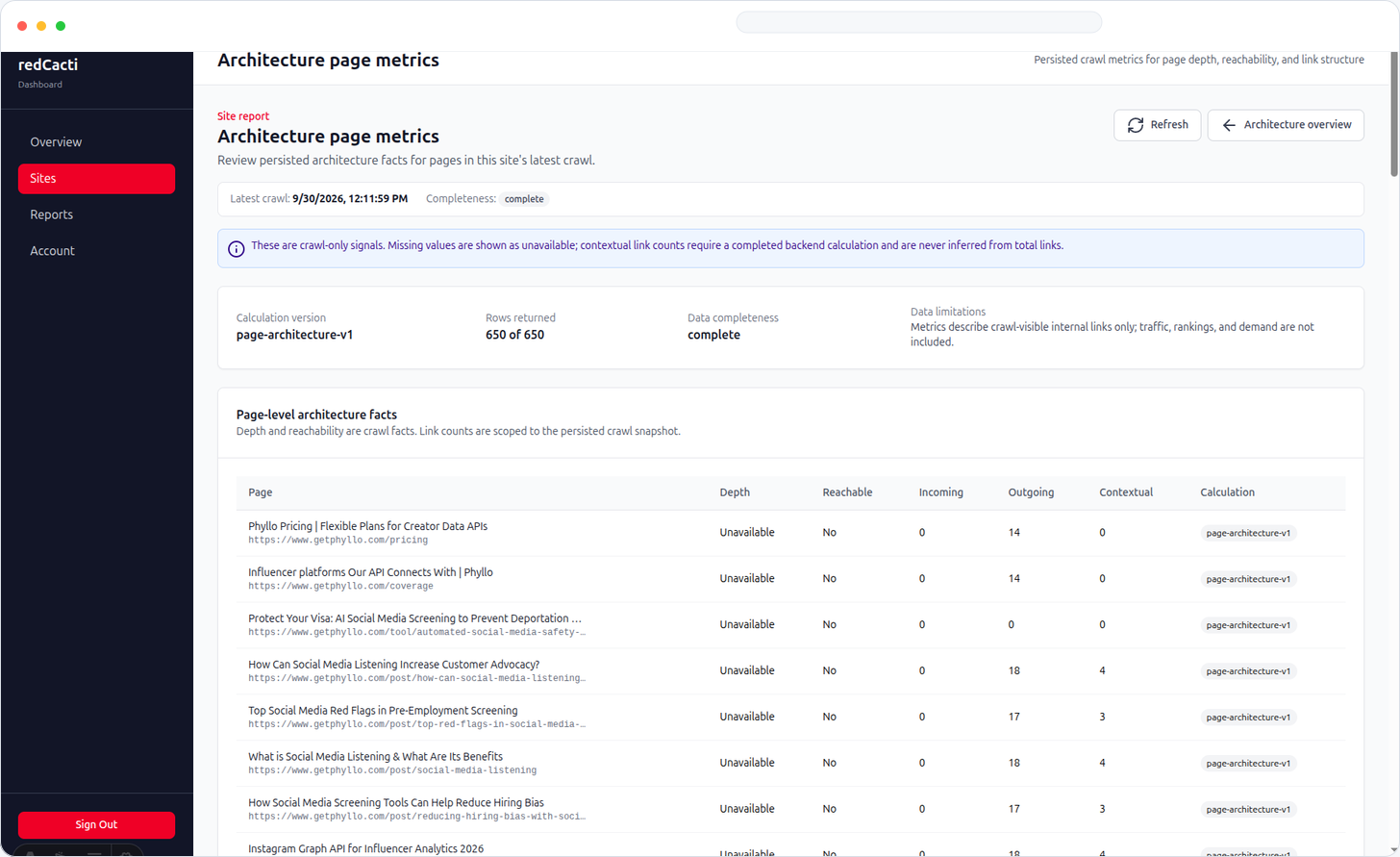
A review loop with evidence
Map public pages and links.
Open architecture evidence.
Review confidence and impact.
Choose the work that fits your team.
Run a later crawl and check the change.
Use crawl evidence to guide structural work. Add your team's traffic, search, editorial, and business context before making a change.
Plan stronger contextual paths across product, use case, and editorial content.
Review discovery paths, redirects, errors, sitemap signals, and crawl constraints.
Turn crawl evidence into a focused queue of internal-link opportunities.
Run a practical first crawl for broken internal and external links.
A crawl maps pages and the links between them. redCacti can surface crawl depth, reachability, incoming links, contextual link placement, page classification, isolated pages, and fragmented clusters in the crawl evidence.
Use the crawl to review structure, then add traffic context, search demand, editorial goals, and business priorities when deciding what to change.
No. The workflow is review first. Your team chooses what to change, makes human-approved updates, then compares a later crawl with the earlier evidence.
A crawl shows whether a page was reachable from the crawl starting point and how it was linked. Use search engine inspection data when you need to check indexation.